

Modeling the Hidden Connections Between Deep Geothermal Wells and Surface Hot Springs
Geothermal energy is one of the more promising tools in the clean energy toolkit: it's local, reliable, and doesn't depend on the weather. But tapping into it means drilling deep into the earth's plumbing — and that plumbing is often connected to things people care about on the surface, like hot springs, streams, and water rights. A new study out of Colorado's Upper Arkansas Valley shows just how important it is to understand those connections before a single well is drilled, and Neptune sees it as a useful case study for how the industry should be approaching geothermal development going forward.
The site: a hot spring sitting on a fault system
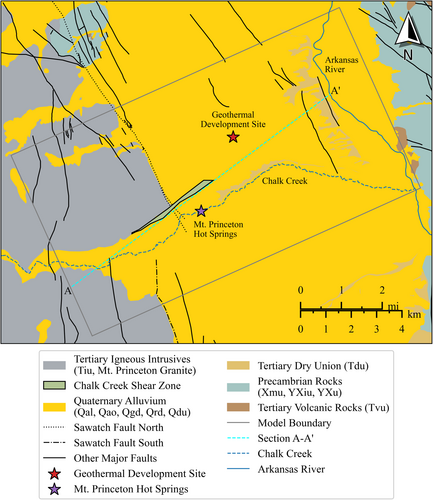
The study focuses on Mt. Princeton Hot Springs (MPHS), fed by geothermal water that rises through a network of steeply dipping faults and fractures known as the Chalk Creek Shear Zone (CCSZ). This fault system has quietly carried heat from deep in the earth to the surface for a very long time. In 2024, a developer proposed a binary-cycle geothermal power plant in the area — extracting hot water from roughly a kilometer or more underground, running it through a power plant, and reinjecting it elsewhere. The obvious question: what happens to everything else connected to that same underground system?
The model: coupling heat and water for the first time at this scale
To answer that, researchers built a fully three-dimensional model that couples groundwater flow and heat transport, using a new simulation tool called MODFLOW 6 GWE. Earlier modeling approaches in this space typically fixed temperature and water-level conditions at the land surface, which prevented any prediction of how shallow water levels or temperatures might actually respond to deep pumping. This model instead lets the shallow system respond dynamically to changes far below it.
The model was calibrated against real-world data — water levels in wells, long-term streamflow averages, temperatures at hot springs and wells, and underground thermal gradients — and the fit was strong, particularly for water levels and streamflow, giving confidence in the scenarios that followed.
Four injection scenarios, four very different outcomes
Researchers tested four scenarios, each extracting the same volume of hot water but reinjecting it in a different direction relative to the extraction well: north, south, east, or west.
The results varied substantially:
Injecting east or north allowed the extraction well's influence to reach the CCSZ before reinjected water could offset it. Over a 100-year simulation, this produced meaningful declines at the hot springs — temperature drops of up to 5.6°C, water-level declines exceeding a meter, and spring flow reductions of nearly 11%. These scenarios also reduced groundwater discharge to Chalk Creek.
Injecting west produced the opposite effect — increased warming, higher water levels, and stronger spring flow — but this direction runs into low-permeability granite, making it the least practical option to actually drill.
Injecting south had minimal impact on the springs, thanks to a naturally efficient north-south flow pathway that let the injection well effectively supply the extraction well.
In three of the four scenarios, the model also predicted measurable depletion of Chalk Creek's groundwater — relevant under Colorado's legal threshold for "tributary" groundwater, which can determine whether a project sails through water-rights review or runs into regulatory complications. The Arkansas River, by contrast, was unaffected in every scenario, since no permeable structures connect it to the deep system.
The researchers also tested the robustness of these findings by adjusting deep rock permeability values and trying two alternate geologic interpretations (a different depth to bedrock, and explicit representation of fault breccia zones). The core pattern held across all configurations: wherever a fault system links deep pumping to shallow springs, that connection works in both directions.

Why this matters for the industry
This is the first study to apply this level of coupled thermal-hydrologic modeling to a real, complex geothermal system, and to do so predictively — before development begins rather than after impacts are observed. For an industry balancing the clear benefits of geothermal energy against the risk of degrading irreplaceable natural features and triggering water-rights disputes, this kind of modeling offers a practical path forward: understand the subsurface connections, test well placement scenarios in advance, and site projects accordingly.
Neptune sees this as a strong example of how thoughtful, well-calibrated groundwater modeling can help geothermal development move forward responsibly — protecting both the resource being developed and the surface features and communities connected to it.
Read the full paper here in Groundwater